
'Even if the media is partisan, the BJP, governing at the Centre, has the most to lose if India descends into widespread communal violence.' 'Fanning the flames either by vested political interests or by partisan reports only plays into the hands of those seek a conflagration.'

'He is a man whose utterances have been so virulent and communalistic.' 'That's why many people did not look at him as the party's choice for chief minister.' 'UP is the state that reports the largest number of communal incidents every year.' 'Modi may not be using the Hindutva card, but he never condemns the incidents too.'
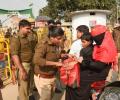
Authorities said social media posts will be monitored to ensure that no attempt is made to vitiate the atmosphere.

'Kejriwal has given not only Modi and Shah some food for thought, but also to jaded Opposition leaders who must now wonder whether taking on the BJP's majoritarianism by the horns, as they have been doing so far, is the appropriate strategy in such extraordinary times,' notes M K Bhadrakumar.

'The way opposition parties such as the Nationalist Congress Party, Shiv Sena, the Samajwadi Party, Rashtriya Janata Dal and the Jharkhand Mukti Morch have supported her, if she wins, she will be the biggest opposition face for 2024'
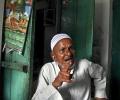
Born in Ayodhya, Ansari was the first to file the suit on the matter in the court of civil judge of Faizabad in 1949.

Bharati Dutt witnessed life-changing events that shaped India on the threshold of freedom. Her memories are an account of how ordinary Indians saw India change.
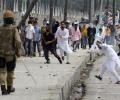
'There is a problem with the rise of a popular view that sees Kashmir through the prism of the larger, chronic Hindu-Muslim tensions.' 'By redefining the Kashmir problem simplistically in Hindu-Muslim terms could end up keeping Kashmir but losing most Kashmiris,' says Shekhar Gupta.

'... That they should emerge as role-models to be emulated by the fellow countrymen; and that the middle classes should not stick only to hate-filled and scornful criticism and condemnation against the state of affairs,' remembers Mohammad Sajjad.
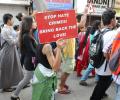
'The prime minister has merely paid lip service condemning these crimes instead of launching a massive crackdown against such brutalities,' argues Professor Mohammad Sajjad.

Though Mohammed Hashim Ansari was the oldest litigant in the case and was against the Ram temple coming up at the site, he never spoke ill of his neighbours who were Hindus.

'If Ruttie had been alive, Jinnah would never have turned communal.'

Gandhi also took a potshot at the RSS, saying it was bent on changing the country's Constitution.

'Our policy seems to be to give away part of J&K, even though we are entitled to the entire state.' 'The Congress has done so, and the BJP is following the same policy.' 'No one is applying their mind to the legal position.' 'Kashmir is not a part of Pakistan under its own constitution.'

'We are passing through a very historical moment. The UP election next year and the Lok Sabha election of 2019 will decide the course of India.' 'Maybe the unlettered will save India again because they have inherited a different India and a different idea of India,' says eminent social scientist Achyut Yagnik.

'The reason I call Dadri a landmark turning point in our politics is the relatively muted response of the self-styled secular forces.' 'Top leaders of the Congress haven't even taken a padyatra to the village, just a 40 minute drive from Delhi. Lalu, Nitish, Mamata, all claimants to the secular vote, are afraid of messing with an issue involving the cow.' 'Holiness of the cow has now become as multi-partisan an issue as hostility to Pakistan,' says Shekhar Gupta.
Attorney General Mukul Rohatgi's stand that AMU is not a minority university reveals the anti-minority stand of the political party now in power, says Mohammad Sajjad, outlining the long history behind one of India's premier universities.

'In a competitive industry where no one has a formula for success other than the actor's personal appeal, the need to dominate the news cycle in the interim between films is so overpowering that even the otherwise sober stars can suffer a Ghajini moment,' says Saisuresh Sivaswamy.

India's majoritarian regime is now making a dangerously fast-paced move towards theocracy, like its western counterpart did a few decades ago, warns Mohammad Sajjad.

Theatre director Saif Hyder Hassan talks about his new play Ek Mulaqat.

Honesty coupled with pragmatism translates to good governance. Honesty plus hubris and self-righteousness spells disaster: that is what the AAP is, says Vivek Gumaste
The families that were affected by the communal violence in Muzaffarnagar district have no hope of their homes being restored to them. Is the government really unable to reassure them of a safe return?

'Some of his decisions were not so good, but his intentions were always guided by a deep national interest.'

'Manto is the only writer to grasp what the project of Pakistan would eventually mean,' says Aakar Patel, who has translated a collection of Saadat Hasan Manto's essays in a just-released book Why I Write.
Rai says the story is a 'sordid saga of the relations between the Indian state and minorities'.

The man behind Aligarh Muslim University 200 years on.

'They must bow their head before the people's might and start their work immediately. Now nothing can help them, but a show of sincerity and a life without cosmetic frills.' 'They don't have any option, but to succeed and prove themselves worthy of this massive victory,' says BJP MP Tarun Vijay.
'Disturbingly, the dissenting judgment of the Supreme Court has raised doubts whether religion, race, caste, community, language etc can be separated from politics at all. It has rightly underlined that this question should to be addressed by Parliament rather than the Supreme Court,' says Dr Madhav Godbole, the former Union home secretary.
Just like with millions of Indian Muslims, even the vice president of India has been forced to undergo the covert loyalty test: 'you are presumed to be pro-Pakistan until you demonstrably prove you are a nationalist', says Shehzad Poonawalla.

In October 2007 Raja Sen visited Louisiana governor Bobby Jindal's village in Punjab to find out how its residents, and relatives, feel about their oddest export. His report was published in India Abroad, a weekly newspaper published in the US and owned by Rediff.com.
The elections in two eastern Indian states were keenly observed in Bangladesh for two major contentious issues, writes Prakash Bhandari from Dhaka.

Jaswant speak of his new book India At Risk, Mistakes, Misconceptions and Misadventures of Security Policy and explains to Sheela Bhatt why India is at risk.

Why Dalit leaders cross over to the BJP
 © 2026 Rediff.com - Advertise with us - Disclaimer - Privacy Policy - Sitemap - Feedback - About us - Terms of use - Grievances